
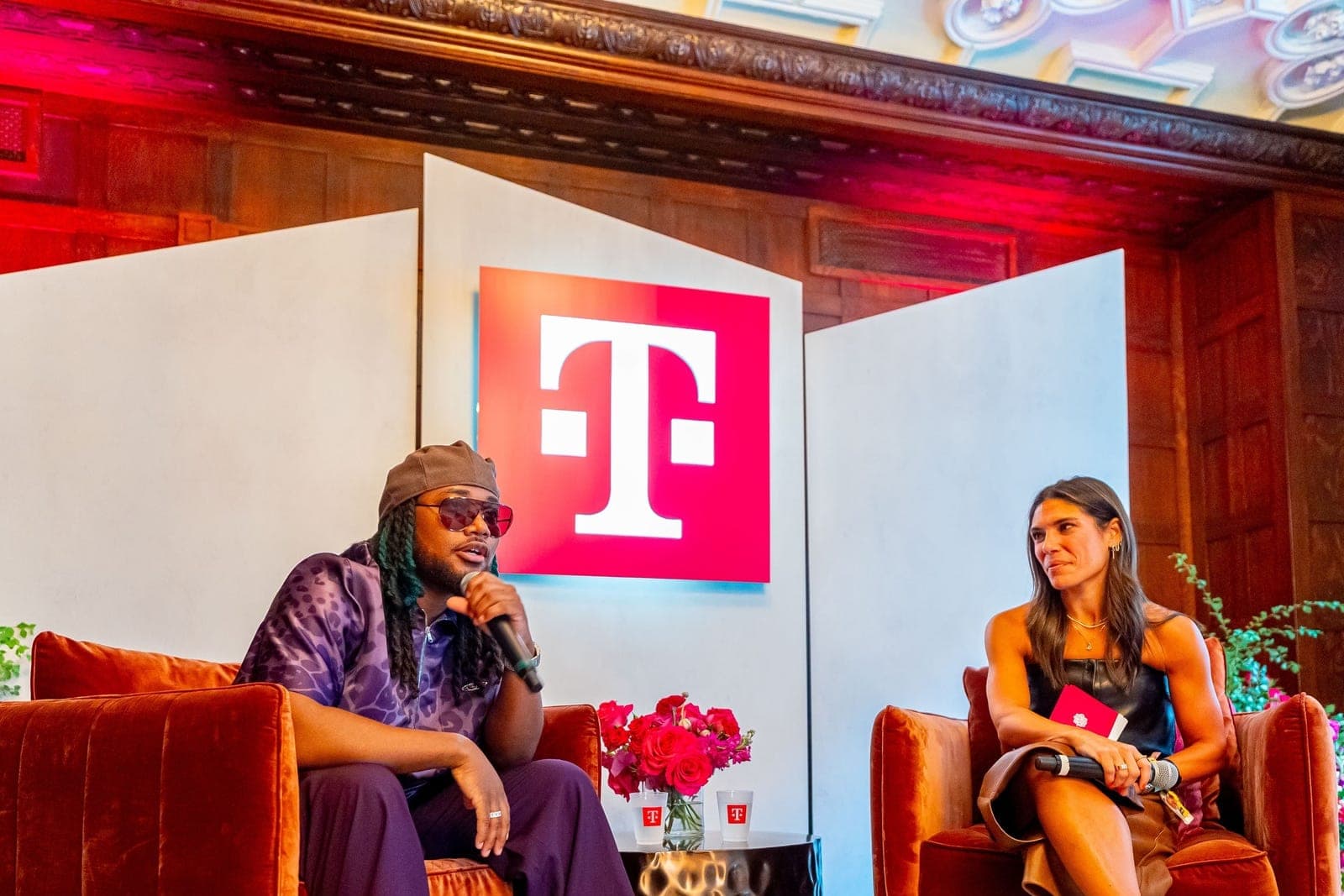
Leon Thomas played Lollapalooza and then went straight to the party. After his set he turned up at T-Mobile's Club Magenta with DJ Toney Handsome and danced with the crowd, and the room went up when he produced Make It Shine from his Victorious days.
The conversation he sat for afterwards, with Michele Boileau-Barmash, founder of TWENTY6 Communications, covered the year behind him and the one he is assembling.
Why he wants children to see the guitar
One subject he keeps circling back to is music education, which he points out is being cut out of schools. What he wants is for a child to see him on stage holding a guitar and go home asking for lessons. He would like the next generation to be musically literate rather than only musically online.
The year behind him
Most people met him as Andre on Victorious. Mutt, the album he put out in 2024, reset that entirely. It brought a run of Grammy nominations and two wins, one for the year's best R&B album and one in the traditional R&B performance category. On the night itself he sang in the medley for the new artist nominees, then took part in the segment honouring D'Angelo and Roberta Flack that Ms. Lauryn Hill led. Pholks followed last year, a mixtape that puts instruments ahead of production, and this year he has been out on The Romantic Tour with Bruno Mars. Lollapalooza is one date inside a long stretch of festivals and shows.
A tribute arranged in four days
The call about the Grammy tribute came roughly four days before the ceremony, which he describes as nerve wracking on the grounds that he was the new kid in the building, sweating through rehearsals. The reason it mattered runs deeper than the booking. He is a serious D'Angelo listener, and Bob Power, who engineered much of D'Angelo's early work, was his mentor. Being asked to help mark that catalogue was not a small thing to him.
What the crowd gave back
The party after his set is the part he talks about most warmly. Coming down from a stage in front of that many people leaves a gap, and playing the Nickelodeon era songs into a room that was jumping filled it. He describes being able to see people's faces and take the appreciation in person rather than through a screen, and says building places where fans can connect is the most useful thing an artist can do at the moment.
In the studio
He calls himself a mad scientist about genre, permanently mixing, drawing on other artists and on much older records. What he is guarding is the narrative. Storytelling is the part of songwriting he cares about, and the challenge inside R&B, where the subject is almost always love, is finding another frame for the same thing.
What Babyface told him
Working with Babyface early on, Thomas turned up weighed down by expectations about what he owed the genre. The conversations he values most are the ones where Babyface took that overthinking apart and told him he was already enough, and that presenting his own version of cool would be sufficient. He says the advice has held. He also mentions the corridor in that studio, plaques from floor to ceiling, which he goes back to whenever he needs a sense of scale.
What he learned from Bruno Mars
On tour he treated the headline set as a class. He would do his own thirty minutes, shower, then go and sit next to the engineer and take notes. What struck him was the precision. He watched Mars sound check a single song twenty times over one detail, and he traces the memorability of those shows straight back to that habit.
He also learned about scale, since a crowd that size needs much broader movement than a club does. Off stage, the two of them talked about Prince, who Thomas puts at the top of any list of people who can hold a stage and play at the same time. He credits Mars and Anderson .Paak with turning into genuine friends over the run.
The next record
It is in progress, and his pitch for it is straightforward. A great deal of love is going into the thing, and he hopes people enjoy what the team is putting together.